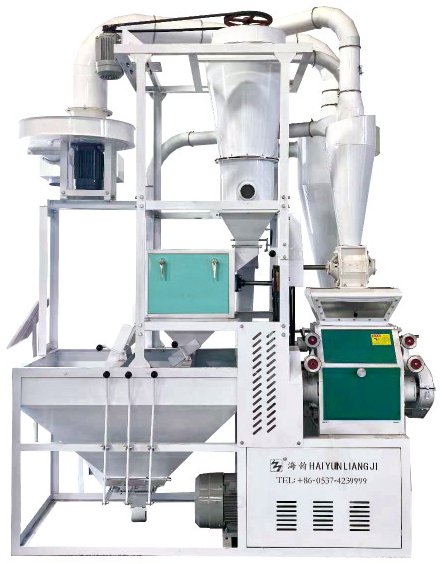
Small factory · 16–18 t/d
6FSZ-20 Five Mill Unit
A complete mini-mill: cleaning, 3B2M milling, sifting.
- 60+ years manufacturing
- 10–500 t/d capacity range
- 100+ patents
- Turnkey commissioning
Overview
What this plant actually is
The five-mill unit is the smallest configuration that behaves like a real flour factory. Cleaning is included — a gravity destoner, a wheat scourer and a washing destoner — and the mill runs a 3 break / 2 reduction flow sheet with either a conical screen or a twin-bin plansifter.
Complete cleaning section included
3B2M flow sheet — the industry standard for small plants
Cone screen or twin-bin plansifter, customer choice
48–51 kW installed; 16–18 t/day output
Standard models and parameters
All figures are nominal at 380 V / 50 Hz with wheat at 12.5% incoming moisture and 76% extraction. Deviations of ±8% are normal and depend on wheat hardness, roll condition and operator settings.
| Model | Capacity | Power / consumption | Weight / footprint | Configuration |
|---|---|---|---|---|
| 6FSZ-20 C (cone sieve) | 16–18 t/d | 48 kW | 6,000 kg 10 × 5 × 3.5 m | Cone sifter — lower temperature, near-zero retention, ideal for custom milling |
| 6FSZ-20 F (flat sieve) | 16–18 t/d | 51 kW | 8,000 kg 12 × 5 × 4 m | Twin-bin plansifter — better grading, more stable flour, ideal for a fixed product line |
Process flow
- 1 Wheat intake
- 2 Gravity destoner
- 3 Wheat scourer
- 4 Washing destoner
- 5 Tempering
- 6 3B2M milling
- 7 Cone or flat sifting
- 8 Flour / bran
How to select
Pick the cone-sieve version when your wheat changes every week — cone screens retain almost nothing, so switching grain costs you minutes not hours, and the lower sifting temperature protects gluten. Pick the flat-sieve version when you sell one or two fixed flour grades and want the tighter ash curve.
Typical applications
- District-level flour mill
- Contract milling for local bakeries
- Multigrain custom plant
- NGO / government food security projects
Answers
Frequently asked questions
Straight answers to the questions engineers and mill owners actually ask us during plant sizing. If your case is not covered, send the wheat specification and your target tonnage.
Ask an engineer →- What does 3B2M mean?
- Three break passages and two reduction passages. Break rolls open the wheat and scrape endosperm off bran; reduction rolls grind the released endosperm into flour. 3B2M is the minimum flow sheet that can produce a clean patent flour.
- How many people run a five-mill plant?
- Three per shift: one at intake and cleaning, one at the mill floor, one at packing. With pneumatic conveying, two is workable.
- What building does it need?
- A 10 × 5 × 3.5 m bay with a 200 mm reinforced slab and 3 m clear height at the mill floor. No tower is required for the cone version.
Continue
Next: SFM Stone Mill Series
28–30 rpm. Cold stone. The flour the premium market pays for. — 50–600 kg/h
View SFM Stone Mill Series →Next step
Send your tonnage. Get a flow sheet in 12 working hours.
Send us: daily capacity target, wheat type and quality, available building dimensions, and local power supply. We reply within 12 working hours with a preliminary flow sheet, equipment list and budget range — no obligation.