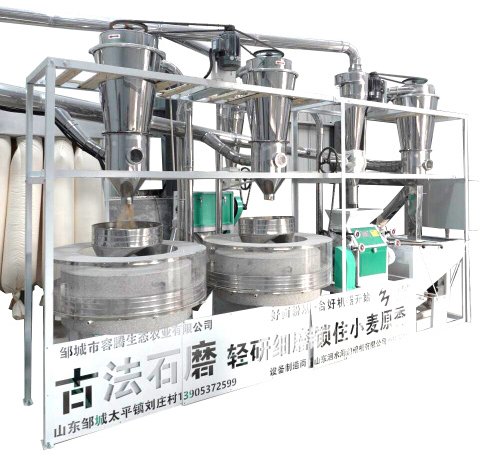
Specialty / premium · 50–600 kg/h
SFM Stone Mill Series
28–30 rpm. Cold stone. The flour the premium market pays for.
- 60+ years manufacturing
- 10–500 t/d capacity range
- 100+ patents
- Turnkey commissioning
Overview
What this plant actually is
Stone milling is not nostalgia — it is a thermal argument. At 28–30 rpm the stone generates a fraction of the heat of a roller mill, so the starch granule and the gluten network arrive intact. The commercial consequence is a flour that behaves differently in the hand and sells at 1.5–2× the price.
Low-speed cold grinding preserves vitamins and gluten
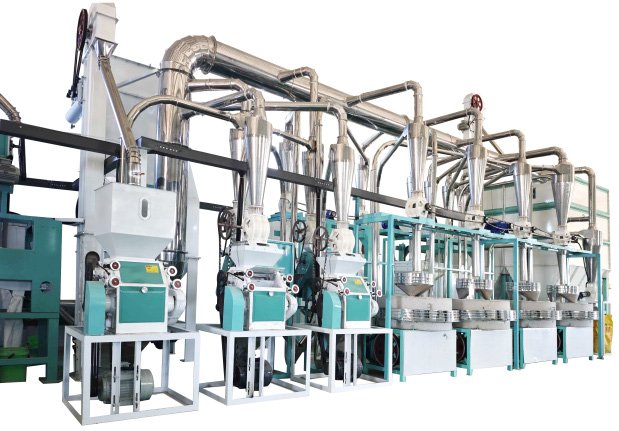
SFM-1+2 and SFM-3+4 hybridise roller and stone for higher yield
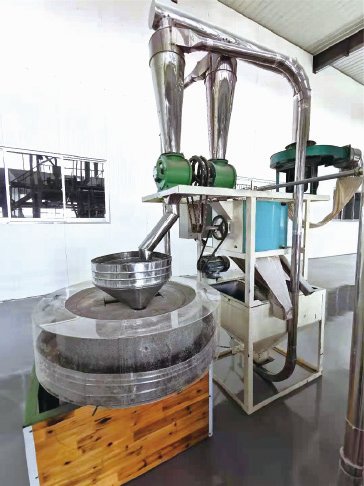
Automatic feeding, sifting and grinding in one unit (SFM-100)
Ideal for whole wheat, buckwheat and multigrain premium lines
Standard models and parameters
All figures are nominal at 380 V / 50 Hz with wheat at 12.5% incoming moisture and 76% extraction. Deviations of ±8% are normal and depend on wheat hardness, roll condition and operator settings.
| Model | Capacity | Power / consumption | Weight / footprint | Configuration |
|---|---|---|---|---|
| SFM-100 | 50 kg/h | 6 kW | — 3 × 2 × 3.2 m + H | Single stone unit with automatic feed and sifting |
| SFM-1+2 | 200 kg/h | 21 kW | — 6 × 5 × 4 m + H | 1 roller mill + 2 stone mills; roller splits, stone grinds |
| SFM-3+4 | 600 kg/h | 80 kW | — 24 × 6 × 4.5 m + H | 3 roller mills + 4 stone mills; one-pass core extraction |
Process flow
- 1 Wheat intake
- 2 Cleaning
- 3 Tempering
- 4 Roller split (SFM-1+2 / 3+4)
- 5 Core collection
- 6 Stone grinding
- 7 Sifting
- 8 Flour
How to select
If you are selling to health-food distributors, buy the stone line and market the temperature. If you are selling to a bakery that needs volume, buy a roller plant and add one stone unit for a premium SKU. Trying to run a stone-only line at 20 t/day is a common and expensive mistake — stone capacity scales linearly with stone diameter, not with pressure.
Typical applications
- Premium whole wheat flour
- Buckwheat and multigrain flour
- Organic / additive-free lines
- Export to health-food markets
From the brochure
SFM Stone Mill Series
Photographs and parameter panels reproduced from the 2026 wheat milling catalogue. Dimension drawings and equipment lists are the original manufacturer figures.
Answers
Frequently asked questions
Straight answers to the questions engineers and mill owners actually ask us during plant sizing. If your case is not covered, send the wheat specification and your target tonnage.
Ask an engineer →- Why is stone-milled flour more expensive?
- Stone output per kW is roughly one fifth of a roller mill, so capital and energy per tonne are higher. The market pays for it because the flour retains carotenoids and vitamin E at levels roller milling destroys.
- Does stone milling damage the stone?
- Dress the stones every 300–500 operating hours. Undressed stones smear instead of cut, which raises flour temperature and defeats the entire purpose.
- Can SFM units run 24 hours?
- Yes, but stone surface temperature must stay under 45 °C. Continuous operation requires a water-cooled stone hub or a forced-air shroud on the stone housing.
Continue
Next: 6FTDP 20–30 t/d Flour Plant
The workhorse: 3B2M to 4B4M, fully documented flow sheet. — 20–30 t/d
View 6FTDP 20–30 t/d Flour Plant →Next step
Send your tonnage. Get a flow sheet in 12 working hours.
Send us: daily capacity target, wheat type and quality, available building dimensions, and local power supply. We reply within 12 working hours with a preliminary flow sheet, equipment list and budget range — no obligation.