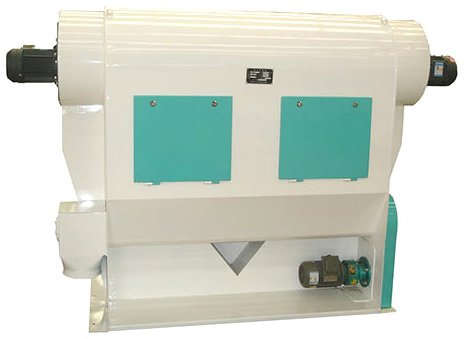
Primary cleaning · Model TQLZ
Self-Balancing Vibrating Screen
The reference machine for large, medium and light impurity separation.
- 60+ years manufacturing
- 10–500 t/d capacity range
- 100+ patents
- Turnkey commissioning
What it does
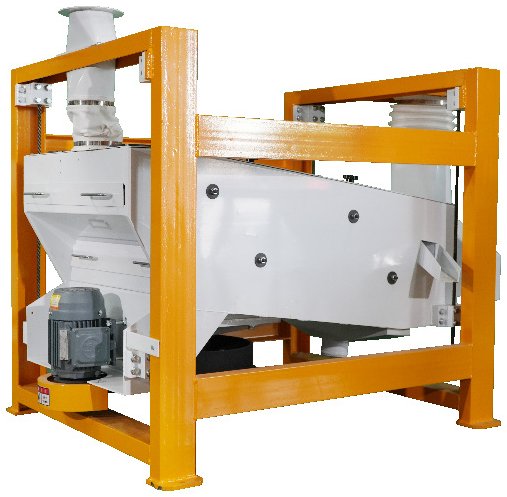
TQLZ is the workhorse screen of the flour industry, and for good reason: a counterweighted self-balancing drive means the frame does not transmit vibration into the building, so it can sit on a mezzanine without a separate isolation foundation.
Technical parameters
Nominal values at standard conditions. Confirm final specification on the order drawing.
| Model | Screen size (cm) | Pre-clean (t/h) | Clean (t/h) | Power | Weight | Dimensions (mm) |
|---|---|---|---|---|---|---|
| TQLZ60×100 | 60 × 100 | 20 | 8 | 2 × 0.25 kW | 360 kg | 1640 × 1550 × 1455 |
| TQLZ100×100 | 100 × 100 | 30 | 8 | 2 × 0.25 kW | 420 kg | 1640 × 1610 × 1455 |
| TQLZ100×150 | 100 × 150 | 50 | 12 | 2 × 0.37 kW | 520 kg | 2140 × 1610 × 1455 |
| TQLZ100×200 | 100 × 200 | 60 | 16 | 2 × 0.37 kW | 540 kg | 2640 × 1610 × 1455 |
| TQLZ150×150 | 150 × 150 | 75 | 18 | 2 × 0.55 kW | 630 kg | 2140 × 2160 × 1455 |
| TQLZ150×200 | 150 × 200 | 100 | 24 | 2 × 0.75 kW | 650 kg | 2640 × 2160 × 1455 |
| TQLZ180×200 | 180 × 200 | 120 | 28 | 2 × 1.1 kW | 1,000 kg | 2740 × 2510 × 1980 |
Selection guidance
Match cleaning capacity (not pre-cleaning capacity) to your mill throughput. A 30 t/d plant needs a TQLZ100×150 at minimum, sized on the cleaning column at 12 t/h over a 10-hour effective working window.
Maintenance
Rebound rubber and screen frames are consumables — budget for one set per 18 months on two-shift operation.
Selection cross-check
Primary screens: self-balancing vs plane rotary
Once coarse impurities are out, the wheat needs efficient size grading. Both machines do it; they differ in how the motion is generated and what that costs.
This machine
Self-Balancing Vibrating Screen
TQLZ
Choose it when
The default choice for any plant above 10 t/d. The counterweight system cancels the reaction force, so it can be mounted high in a frame without transmitting vibration into the structure.
Watch out for
More bearings and a more complex drive than a plane rotary sifter, so maintenance skill matters. Rubber mounts need replacing on a 2–3 year cycle.
Alternative
Plane Rotary Sifter
TQLM
Choose it when
Smaller mills and pre-cleaning duties where gentle action matters, or where the wheat is fragile and you want to minimise breakage.
Watch out for
Lower capacity per unit area. The eccentric drive is simple but imposes a reaction force on the structure, so it needs a heavier support frame.
Open Plane Rotary Sifter →Decision rule
Self-balancing for capacity and structural freedom; plane rotary for gentleness and simplicity at small scale.
Answers
Frequently asked questions
Straight answers to the questions engineers and mill owners actually ask us during plant sizing. If your case is not covered, send the wheat specification and your target tonnage.
Ask an engineer →- Why is cleaning capacity so much lower than pre-cleaning capacity?
- Cleaning requires the grain to spend far longer on the screen so that small impurities can pass. The same deck area therefore handles roughly a third of the throughput when it is doing real cleaning rather than rough scalping.
From the brochure
Self-Balancing Vibrating Screen catalogue images
Photographs and parameter panels reproduced from the 2026 catalogue. Captions are the original brochure text.
Next step
Send your tonnage. Get a flow sheet in 12 working hours.
Send us: daily capacity target, wheat type and quality, available building dimensions, and local power supply. We reply within 12 working hours with a preliminary flow sheet, equipment list and budget range — no obligation.