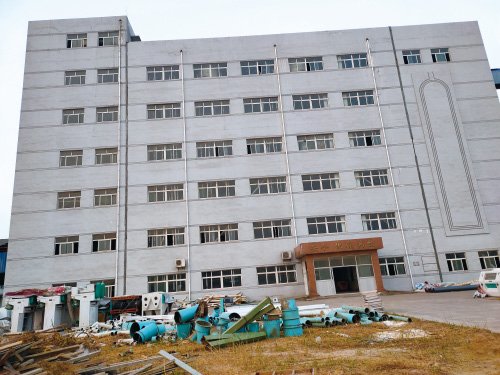
Turnkey — twin-line design, supply, installation, commissioning · 2022
Yuncheng 500 t/d flour plant
The largest plant delivered to date: two parallel 250 t/d lines with shared intake, separate milling floors and a common packing hall, running at 65–70 kWh/t.
- 60+ years manufacturing
- 10–500 t/d capacity range
- 100+ patents
- Turnkey commissioning
Capacity
500 t/d
Installed power
1,650 kW
Specific power
65–70 kWh/t
Lines
2 × 250 t/d
Building
60 × 10 × 24 m
Extraction
77% patent
郓城 500 吨面粉厂 · Yuncheng County, Heze, Shandong, China
The brief
The client is a Shandong flour group supplying national retail brands. The requirement was 500 t/d with the ability to run one line while the other is under maintenance — a continuity requirement that rules out a single 500 t/d train.
Two parallel 250 t/d lines sharing intake, wheat storage and packing is the standard solution, but it creates its own problems: shared intake becomes the single point of failure, and shared packing means a packing stoppage stops both lines.
What constrained the design
Four constraints that shaped the plant more than the capacity figure did.
Continuity without duplication
Two milling lines, but a single intake and a single wheat cleaning house. The intake is sized at 210 t/h — enough to fill both lines' tempering bins in a single shift — and the cleaning house is duplicated internally so one half can be maintained while the other runs.
Packing as the bottleneck
At 500 t/d the plant produces 385 t of flour per day. That is 15,400 × 25 kg bags, or roughly 12 bags per minute continuously. Three packing lines were installed, not two — one more than the arithmetic requires, because a single packing stoppage otherwise backs flour up into both sifters within 40 minutes.
Power supply
1,650 kW installed draws roughly 1,400 kW average, which is a 2,000 kVA transformer with margin. The local supply required a dedicated 10 kV feeder and a 2,500 kVA transformer. Staggered starting was mandatory: simultaneous start of both lines would have created a demand spike that set the monthly charge for the whole plant.
Building height
24 m to the eaves, 27.5 m total. Two independent gravity flow paths stacked in one building, with separate sifter floors so a sifter intervention on one line does not affect the other.
What was built
| Intake | 80 t weighbridge, 210 t/h receiving capacity, two roofed pits, automatic sampling. |
|---|---|
| Storage | Six 2,000 t silos (12,000 t total, ~18 days), all aerated at 0.25 m³/min/t, with temperature cables and a blending system across four of them. |
| Cleaning | Two 30 t/h lines, each internally split so half can be isolated for maintenance. Drum sieve, self-balancing screen, gravity destoner, two scourers, washer-destoner, magnetic separation, dampening to 16.2%. |
| Tempering | Eight bins per line, 24-hour tempering. Independent water and heat control per line. |
| Milling | 4B5M1S1T per line on twelve FMFQ(S) double roller mills per line. 24 roll mills total, 1,000 mm rolls. |
| Sifting | Three FSFG high square plansifters per line, 68 m² per line, 136 m² total — 0.74 t/d per m². |
| Purification | Two FQFD purifiers per line, 8 sections each, with independent aspiration and separate semolina handling. |
| Packing | Three LCS lines, 14 bags/min each, with automatic palletising and a 5 kg consumer line. |
| Dust collection | Six pulse-jet collectors, 240 m² total cloth area, all vented outdoors with explosion venting and isolation. |
Measured outcome
Performance acceptance ran at 507 t/d combined over 72 hours, 77.1% extraction, 66.8 kWh/t. Both lines ran continuously with zero unplanned stops during the test.
Twelve months of operation showed the plant at 68.2 kWh/t average — slightly above the acceptance figure, attributable to running at 88% average capacity rather than 100%.
The third packing line earned its cost twice in the first year. Each time one line stopped for a bag sealer repair, the remaining two absorbed the output with a 40-minute buffer rather than forcing a milling line down.
What we would do differently
The honest section. Every project teaches something that was not in the specification.
- Continuity requirements drive the architecture more than capacity does. A single 500 t/d train would have been 12–15% cheaper in capital and would have had a single point of failure at every stage.
- Packing capacity should be sized at 130% of milling output, not 100%. The cost of a third line was roughly 1.5% of plant capital and it protects the whole plant against the most frequent stoppage.
- Sub-metering at line level, not just plant level, was specified. It is what allowed the client to identify that line 2 was drawing 4% more power per tonne than line 1 within the first month — traced to a sifter drive misalignment that would otherwise have run for a year.
Next step
Planning a plant of this size?
Send us your target capacity, wheat specification and site constraints. We will tell you what a plant like this one would need — and what we would change if we built it today.